

Last weekend, I laced up my boots and headed to Beaver Creek Reserve in Eau Claire County—a beautiful 400-plus-acre mix of upland woods, river bottom forests, wetlands, and savanna just outside Eau Claire. The occasion: a moss hike, one of those wonderfully slow, ground-level experiences that shifts your perspective from the canopy to the carpet underfoot.
As I crouched beside a lush emerald patch of sphagnum moss along a wetland edge, the usual questions kicked in: Who first saw commercial value in this stuff? How did an industry grow from bog moss? And is it still thriving today?
The answers surprised me—and they should surprise most economic developers, nature lovers, and even many longtime Wisconsin residents.
Wisconsin is the only state in the U.S. that commercially harvests sphagnum moss at scale. The heart of the industry lies in the central wetland counties of Jackson, Monroe, Wood, and Clark—just south of Chippewa County and roughly an hour from where I was hiking. These marshes produce a significant share of the world’s long-fiber sphagnum moss, supporting a quiet but globally relevant supply chain.
A 10,000-Year-Old Foundation
The story begins with geology. About 10,000 years ago, the Wisconsin Glacier split as it retreated, leaving behind Glacial Lake Wisconsin and vast marshlands in its wake. In those nutrient-poor, acidic wetlands, prehistoric sphagnum moss— a survivor from the Mesozoic era—found ideal conditions and thrived.
The leap from wild plant to commercial crop came from necessity. During World War I, battlefield surgeons faced a shortage of cotton bandages. A Scottish surgeon-botanist team (Charles Walker Cathcart and Isaac Bayley Balfour) championed sphagnum moss as an alternative. Its natural sterility, antiseptic properties, and remarkable ability to absorb up to 20 times its weight in liquid made it superior for wound dressings. That wartime innovation revealed broader potential: the same moisture retention and fungal resistance that helped heal soldiers make sphagnum ideal for horticulture—keeping nursery plants alive in transit, starting seeds, supporting hydroponics, and preserving cut flowers during shipping.
Demand surged, and Wisconsin’s unique marshes were perfectly positioned to meet it.
A Regenerative, Place-Based Industry
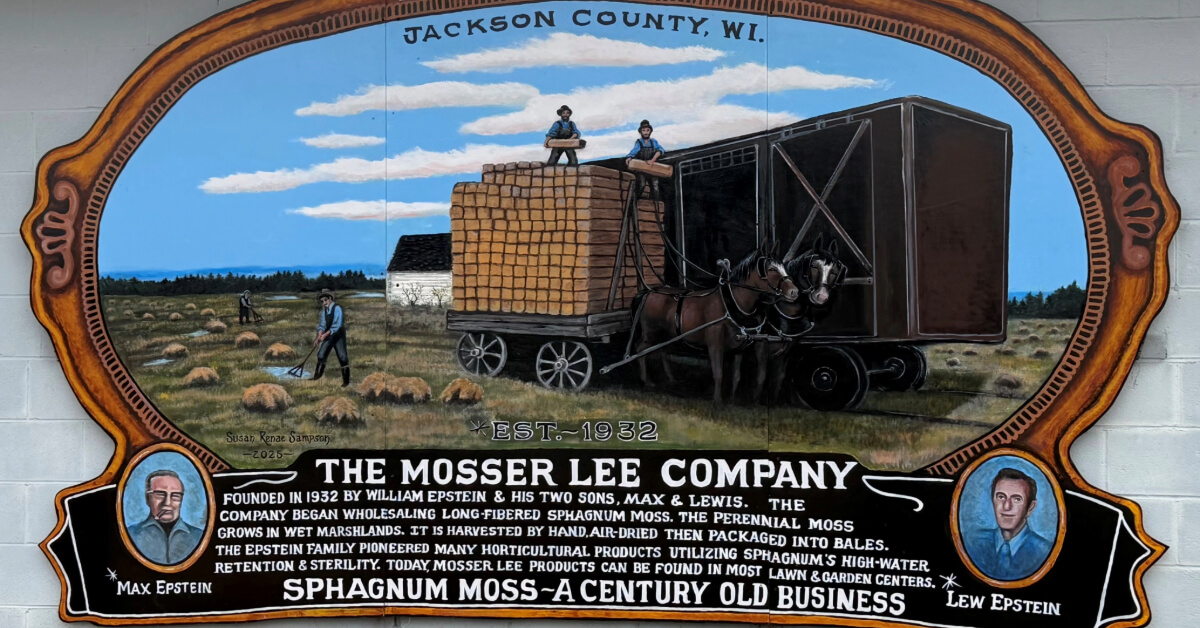
Unlike many extractive industries, sphagnum moss harvesting is regenerative. The plant grows from its base and can be sustainably pulled, leaving the root system and marsh structure intact. Harvesters, known as “mossers,” traditionally wade in wearing hip boots and hand-pull the moss, breaking it cleanly at the soil line. Rotations vary—some marshes are harvested every 5–7 years, others on 10–12-year cycles—allowing full recovery.
This model was practicing regenerative harvesting long before the term became fashionable. Today, hundreds of thousands of bales leave Wisconsin marshes each year, bound for greenhouses, garden centers, research labs, and horticultural operations worldwide.
One standout player is Mosser Lee, founded in 1932 in Millston, Wisconsin (Jackson County). It remains the largest producer and fabricator of sphagnum moss products in North America, serving everyone from the U.S. Department of Agriculture and university programs to professional growers and home gardeners.
Innovation Born from the Bog
What truly marks this as a mature industry is the proprietary innovation it has spawned. Harvesters developed custom tools and machines tailored to the challenging marsh environment— including equipment built from repurposed tractors like the Oliver OC-6—because no standard machinery could handle the wet, soft conditions while gently pulling long-fiber moss.
When entrepreneurs invest in specialized equipment and build dedicated supply chains, you know the sector has real staying power.
Lessons for Economic Development in the Chippewa Valley
Walking the trails at Beaver Creek Reserve, it’s easy to see the moss as just another patch of green. But look closer: you’re seeing the intersection of ancient glacial geology, a century of entrepreneurial vision, wartime medical ingenuity, custom-built technology, and a global market—all rooted in central Wisconsin’s wetlands.
This “invisible industry” offers several powerful takeaways for our region:
- Natural assets are economic assets. Wetlands preserved for ecology can simultaneously support durable, place-based industries when entrepreneurs ask the right questions.
- Renewability creates a competitive advantage. In a world demanding sustainable supply chains, Wisconsin’s regenerative moss harvesting isn’t just environmentally sound—it’s a strong business differentiator.
- Invisible industries deserve spotlight. Sphagnum moss has been a commercial crop here for over 100 years, yet many in the Chippewa Valley have never heard of it. CEDC plays a key role in surfacing these stories, linking them to workforce opportunities, and supporting their growth.
- Conservation and commerce can thrive together. The moss model—careful harvesting that maintains long-term marsh health—offers a valuable template as we pursue balanced, sustainable development.
Next time you’re out on the trails, pause at ground level. That unassuming green carpet is more than scenery. It’s proof that thoughtful stewardship of what makes our region unique can grow into something with global reach.