

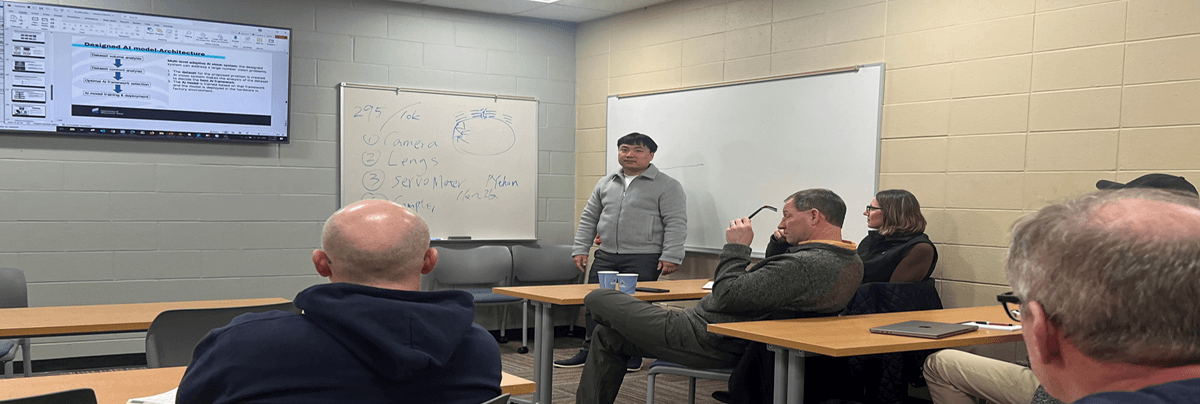
The second session of the Manufacturing Competitiveness in the 21st Century series, held today at the Chippewa Valley Technical College (CVTC) campus in Chippewa Falls, Wisconsin, spotlighted the transformative potential of Vision Inspection with AI Deep Learning. Organized in collaboration with the UW-Stout Manufacturing Outreach Center (MOC), Wisconsin Procurement Institute (WPI), and CVTC, the event brought together manufacturing professionals eager to explore AI-driven automation as a catalyst for operational excellence.
AI-Powered Machine Vision: A New Standard in Quality Control
Dr. David Ding, Professor and Program Director at the University of Wisconsin-Stout’s College of Science, Technology, Engineering, Mathematics, and Management, led discussions on how AI-powered machine vision systems are revolutionizing quality control and defect detection. Using advanced techniques such as pattern recognition, image segmentation, and deep learning, these systems achieve up to 99% accuracy in identifying defects, including scratches, misalignments, and assembly errors—challenges that human inspectors often struggle to detect consistently.
Case studies highlighted the tangible benefits of AI integration, including a 40% reduction in waste and enhanced production line traceability. Additionally, real-time anomaly detection capabilities have helped manufacturers prevent costly recalls, ensuring both product quality and operational efficiency.
Human-AI Collaboration: Enhancing, Not Replacing, Workforce Roles
A key takeaway from the session was the symbiotic relationship between AI and human expertise in modern manufacturing. Industry leaders from Pleora Technologies and ThinkIQ emphasized that AI does not replace human workers but rather enhances decision-making by providing real-time, data-driven insights. This approach allows manufacturers to identify process inefficiencies faster and optimize their production lines more effectively.
However, challenges remain, particularly for small and mid-sized manufacturers. Training AI models with limited datasets and managing the initial investment costs were discussed as potential hurdles. Fortunately, advancements in user-friendly AI platforms and hybrid systems—which combine traditional vision inspection tools with pre-trained AI models—are making AI adoption more accessible than ever.
AI and the Future of U.S. Manufacturing
The session also addressed AI’s strategic role in maintaining U.S. manufacturing competitiveness. Representatives from the ARM Institute outlined national initiatives such as the AI Data Foundry Program, which aggregates manufacturing data to improve robotic precision and scalability. These initiatives are designed to help manufacturers stay ahead in an increasingly automated and data-driven industry.
Attendees left with actionable strategies for implementing AI-powered vision systems, including hardware selection, workflow optimization, and continuous learning processes to maximize the impact of AI in their operations.
Looking Ahead: Strengthening Cyber Resilience
The Manufacturing Competitiveness in the 21st Century series will conclude with its final session, Cyber Culture for Compliance and Competition. This session will focus on strengthening digital resilience in an increasingly connected industrial landscape, reinforcing the broader series themes of innovation, workforce development, and lean manufacturing.
Stay tuned for more insights from CEDC as we continue to explore the cutting-edge advancements shaping the future of manufacturing.